
Well Pump Repair in Augusta, ME
No water or low pressure? We diagnose well pumps, pressure tanks and switches fast and get your water back.
- Google reviews
- Licensed & insured Master Plumber
- Family-owned since 2022
- Free estimates
Free estimates
No-obligation quote before any work starts.
Request a free estimateSame-day service available
Active leaks and no-water calls go to the front of the line.
Call (207) 549-0064No hidden fees
You approve the price before we pick up a tool.
See typical costs
How a Private Well Water System Works
- Submersible pump — sits down in the casing, in the water
- Drop pipe — carries water up and over to the house
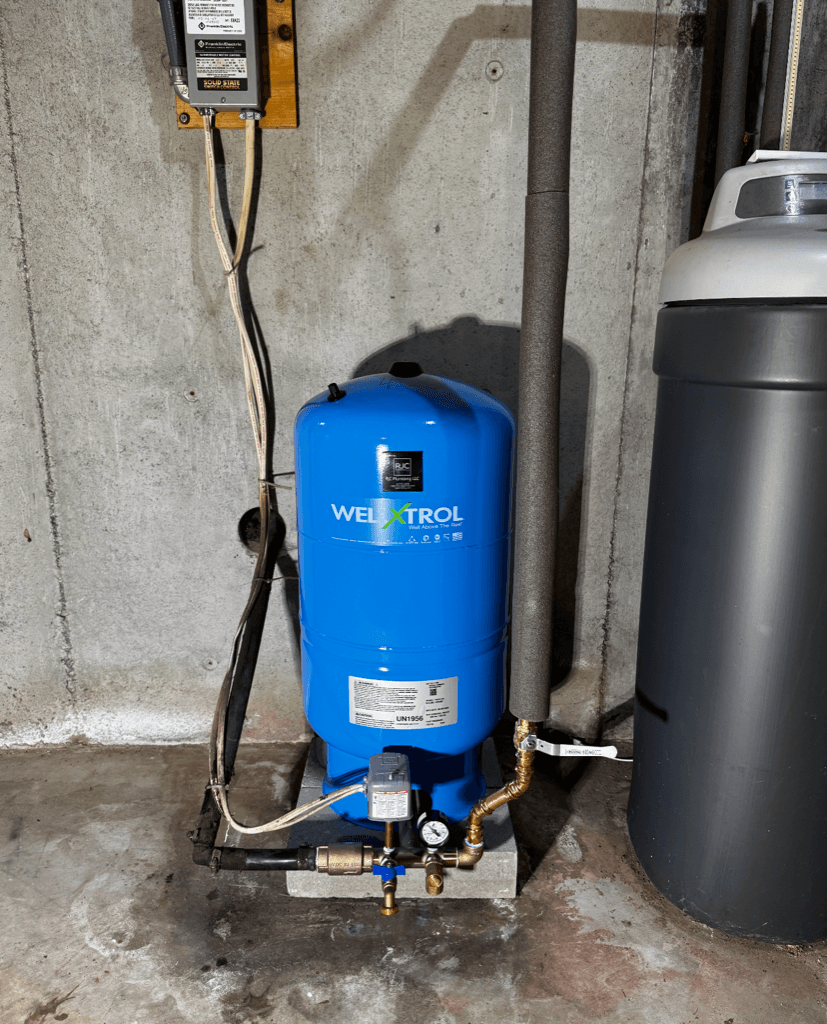
- Pressure tank — stores water so the pump is not always running
- Pressure switch — turns the pump on and off within a set range
- Supply to the house — steady pressure at every fixture
No water, low or surging pressure, or a pump that runs constantly — RJC Plumbing diagnoses and repairs well pumps, pressure tanks, switches and controls for homes on private wells across Augusta and Central Maine.
Signs your well pump or pressure tank needs service
No water at the taps, pressure that surges or drops in the shower, a pump that clicks on and off every few seconds, or a pump that never shuts off. Each points to a different part of the system.
Short-cycling is usually a waterlogged pressure tank. A pump that runs constantly may be a leak in the well line, a bad check valve or a failing pump. No water at all is often the pressure switch or the pump itself.
How do we diagnose a well system?
We check the pressure switch and tank first — they are the most common failures and the least expensive. Then power to the pump, the control box on jet and some submersible systems, and pressure on the well line.
One Augusta-area customer with a failed pressure tank had us on site within 20 minutes and water back in two hours. That is the standard we aim for on no-water calls.
Pressure tank replacement
A pressure tank with a failed bladder makes the pump cycle constantly and shortens its life. We replace it with a correctly sized tank, new tee, gauge, relief valve and pressure switch, and set the air pre-charge to match.
Well pump replacement
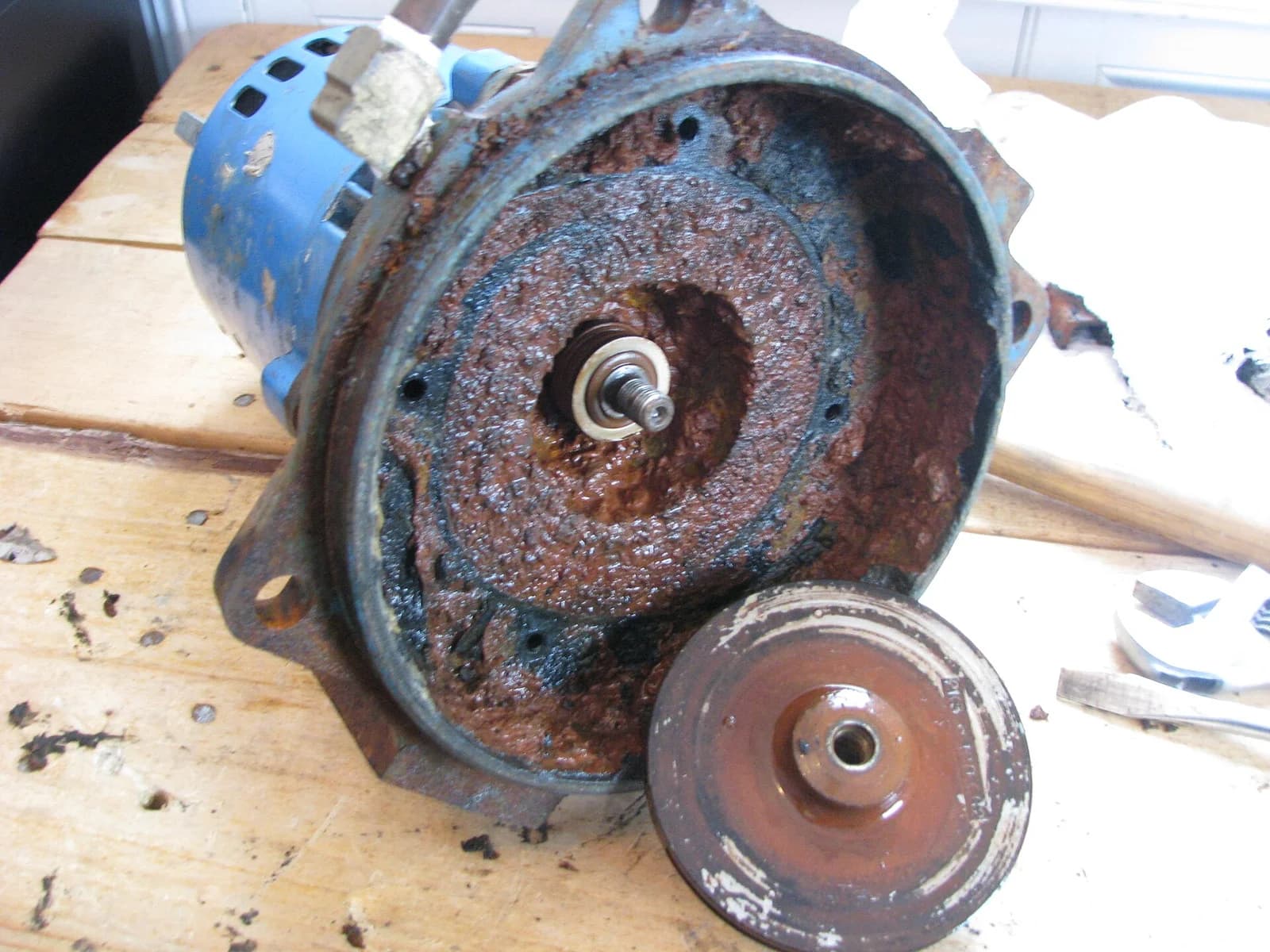
When a pump has failed we replace it and the connections, sized to the well depth and household demand. Jet pumps on shallow wells are repaired or replaced above ground, usually in an afternoon.
If the problem is the well itself — a dry well or a collapsed casing — we will tell you straight away and point you to a well driller rather than sell you a pump you do not need.
What does well pump repair cost in Maine?
$300–$1,200
Typical range for a pressure switch, pressure tank or control repair. Replacing a submersible well pump typically runs $1,500–$4,000 depending on depth and pump size. Every price is confirmed before work begins.
Every job starts with a free, no-obligation estimate — you get the exact price before any work begins.
What well pump repair customers say
sarah compton
April 2025
“Called late on Friday afternoon about no running water and he was very prompt and called back. Knowledgeable, helpful and showed up on Saturday and solved our problem. Highly recommend.”
Ian Bouffard
October 2024
“Very pleased with RJC Plumbing, and happy to support local small business owners. We called on RJC plumbing to fix a failed Well pressure tank. He arrived within 20mins, and had us back up and running in just 2 hrs. They were very prompt and professional. Will be using them again!”
Devin Campbell
July 2024
“RJC installed a brand new propane boiler, water heater and water system at my house. All the work was professionally done and completed in a timely manner. Great customer service and haven't had any issues! Great professional install and best of all I am now saving money on my heating cost. I highly recommend this company to anyone in central Maine.”


Well Pumps: Submersible vs. Jet, Pressure Tanks & Fault Codes
A private well system is really three components working together — the pump itself, the pressure tank, and the pressure switch (or, on a constant-pressure system, an electronic drive) — and a symptom in one often gets blamed on the wrong one. Short-cycling, for instance, is almost never actually the pump's fault, even though replacing the pump is the first thing many homeowners assume they need.
Submersible vs. Jet Pumps
| Type | Where it sits | Typical use |
|---|---|---|
| Submersible | Down in the well casing itself, submerged in the water | Deep wells (most drilled wells in Maine); pushes water up rather than pulling it, which is mechanically more efficient at depth |
| Jet (shallow-well) | Above ground, in a basement or well house, drawing water up through a single pipe | Shallow wells, roughly 25 feet of lift or less |
| Jet (deep-well, dual-pipe) | Above ground, using a two-pipe jet assembly down in the well to move more water at moderate depth | Wells too deep for a single-pipe jet setup but not necessarily calling for a submersible |
Pressure Tanks & Short-Cycling
A pressure tank stores a cushion of water under pressure so the pump isn't switching on and off every time a faucet opens — the tank supplies the first several gallons, and the pump only kicks in once the tank's pressure drops to its low setpoint. When a tank loses its air charge (its "pre-charge"), usually from a slow leak in the internal bladder or the air valve, it can no longer hold that cushion, and the pump starts cycling on and off in rapid succession — short-cycling — every time even a small amount of water is drawn.
Short-cycling wears out a pump's motor and starting components far faster than normal use, so a tank that's lost its pre-charge is worth fixing immediately even though the symptom shows up at the pump. We check tank pre-charge as a first step on any "pump keeps turning on and off" call, before assuming the pump itself has failed.
The Pressure Switch
On a standard (non-constant-pressure) system, a pressure switch mounted near the tank turns the pump on at a low pressure setpoint and off at a high one — commonly a 30/50 or 40/60 psi range. A switch with corroded or pitted contacts can fail to shut the pump off cleanly, stick closed, or fail to start the pump at all, and it's a common point of failure simply because it's a mechanical switch cycling thousands of times a year. We test the switch itself before assuming a no-water complaint is the pump.

Franklin Electric SubDrive / MonoDrive — Diagnostic Fault Flash Codes
Franklin Electric's SubDrive and MonoDrive constant-pressure control drives — common on systems that hold a steady pressure rather than cycling within a 30/50-style range — read out fault conditions as a numbered LED flash pattern on the drive itself. Franklin Electric's own owner's manual (document 225417101) publishes the full quick-reference chart; the table below reflects the flash counts and general causes it documents.
| Flashes | Fault | Common cause |
|---|---|---|
| 1 | Motor underload | Overpumped or dry well, broken shaft/coupling, blocked screen, or the drive not matched to the pump's rating |
| 2 | Undervoltage | Line voltage below roughly 150 VAC, a loose incoming connection, or (NEMA 4 models) a malfunctioning cooling fan |
| 3 | Locked pump | Motor or pump misalignment, a dragging motor, or abrasives inside the pump |
| 4 | Incorrectly wired (MonoDrive only) | Wrong resistance readings on start — check wiring and motor size against the drive's DIP switch settings |
| 5 | Open circuit | A loose connection, defective drop cable or motor, or the wrong motor connected to the drive |
| 6 | Short circuit / over current | A short at power-up, or debris trapped in the pump causing over-current while running |
| 7 | Overheated drive | High ambient temperature, direct sunlight, or blocked airflow around the drive's heat sink |

Other Constant-Pressure Systems
Grundfos's SQE submersible pumps, often paired with a CU 300 or CU 301 controller, are another constant-pressure system we service. Grundfos documents fault indications inside the model- and controller-specific installation manual rather than in one universal public chart, so as with any brand that takes that approach, we identify the exact controller model from its nameplate and pull that manual before diagnosing a specific fault light rather than guessing from a general list.
Signs a Well Pump Actually Needs Replacement
- Water that's sandy, gritty, or has visibly declined in clarity, especially after running for a while — can mean a submersible pump is drawing from silt at the bottom of the well.
- A pump that runs constantly without building pressure, once the tank and pressure switch have both been ruled out.
- A sharp, sudden drop in flow rate that doesn't recover, particularly on an older pump nearing the end of a typical 8-15 year service life.
- An electrical trip (breaker or overload) that repeats even after a reset, which points to a failing motor winding rather than a temporary fault.
Sources: Franklin Electric SubDrive/MonoDrive NEMA 1 and NEMA 4 Owner's Manual (225417101 Rev 7) · Franklin Electric — Drives, Starters & Protection · Grundfos USA
Brand names and logos are trademarks of their respective owners, shown only to identify the equipment discussed. RJC Plumbing is an independent contractor and is not affiliated with or endorsed by these manufacturers.
Well Pump Repair questions from Augusta homeowners
I have no water at all — what should I check before calling?
Check the breaker for the well pump and look at the pressure gauge on the tank. If the breaker is on and the gauge reads zero, call us. Do not keep resetting a breaker that trips; it can damage the pump.
Why does my well pump turn on and off constantly?
Short-cycling is almost always a waterlogged pressure tank with a failed bladder, or one with the wrong air pre-charge. It is a quick diagnosis and a same-day fix in most cases.
Do you replace well pumps or just pressure tanks?
Both. We repair and replace pressure tanks, switches, controls and check valves, and replace failed submersible and jet pumps. Well drilling and casing repair are referred to a well driller.
How long does a pressure tank replacement take?
Typically two to three hours, including draining the system, setting the new tank, switch and gauge, and restoring water.
Can low water pressure be fixed without a new pump?
Often. A clogged sediment filter, an incorrectly set pressure switch, a waterlogged tank or a partly closed valve are all common causes we fix without replacing the pump.
Which areas do you cover for well service?
Augusta, Manchester, Winthrop, Hallowell, Farmingdale, Gardiner, Waterville and the surrounding towns — most of which have homes on private wells.
Related plumbing services
- Kitchen Plumbing
- Bathroom Plumbing
- New Construction
- Emergency Repairs
- Water Heaters
- Pipe Repair
- Drain Cleaning
- Sump Pumps
Well Pump Repair across Central Maine
Get a free well pump repair estimate
Tell us what you need and we will get right back to you — usually within a few hours.
Need it today?Call (207) 549-0064
More ways we can help
Google reviewsGuides & tips
4For practical advice, read our homeowner guides, including
Company
4A few more places to start:
Plumbing services
9Our licensed Master Plumber also takes care of
Service areas
17Neighbors throughout the Kennebec Valley call us, including in
- Central Maine service areas
- Plumber in Augusta, ME
- Plumber in Brunswick, ME
- Plumber in Waterville, ME
- Plumber in Gardiner, ME
- Plumber in Hallowell, ME
- Plumber in Winthrop, ME
- Plumber in Farmingdale, ME
- Plumber in Manchester, ME
- Plumber in Winslow, ME
- Plumber in Oakland, ME
- Plumber in Topsham, ME
- Plumber in Bath, ME
- Plumber in Lewiston, ME
- Plumber in Auburn, ME
- Plumber in Lisbon, ME
- Plumber in Sabattus, ME