

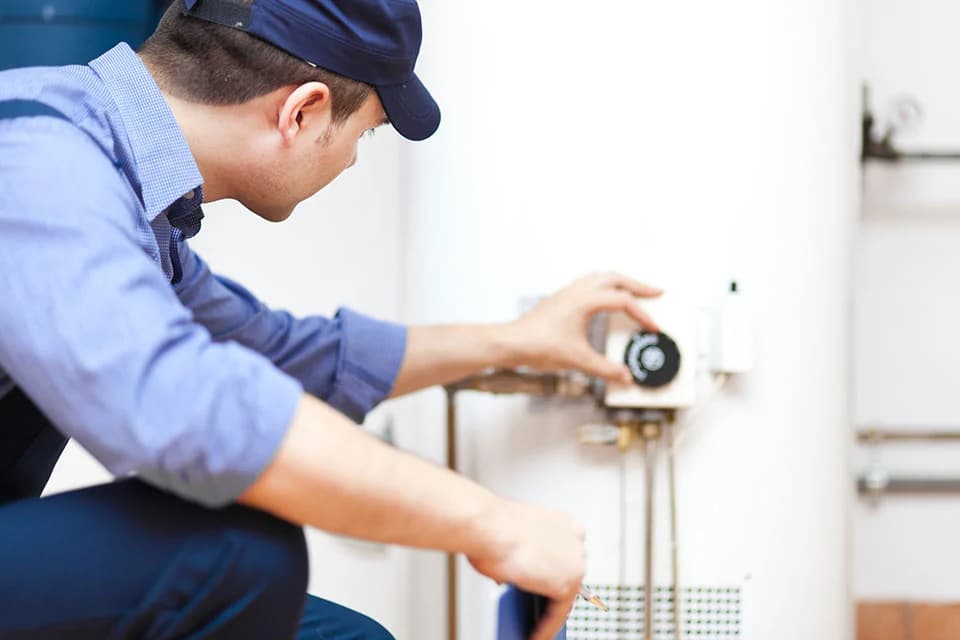
Water Heater Installation & Repair in Augusta, ME
Tank, tankless and hybrid water heaters installed — often the same day your old one fails.
- Google reviews
- Licensed & insured Master Plumber
- Family-owned since 2022
- Free estimates
Free estimates
No-obligation quote before any work starts.
Request a free estimateSame-day service available
Active leaks and no-water calls go to the front of the line.
Call (207) 549-0064No hidden fees
You approve the price before we pick up a tool.
See typical costs
How a Tank Water Heater Works
- Cold inlet — the dip tube carries it to the tank bottom
- Burner — heats water at the bottom of the tank
- Anode rod — sacrificial rod that fights corrosion
- T&P valve — releases pressure if it builds too high
- Hot outlet — draws the hottest water from the top
From traditional tank water heaters to on-demand tankless systems, RJC Plumbing installs, repairs, and replaces water heaters with same-day service available so your home is never without hot water for long.
Water heater repair or replacement — which do you need?
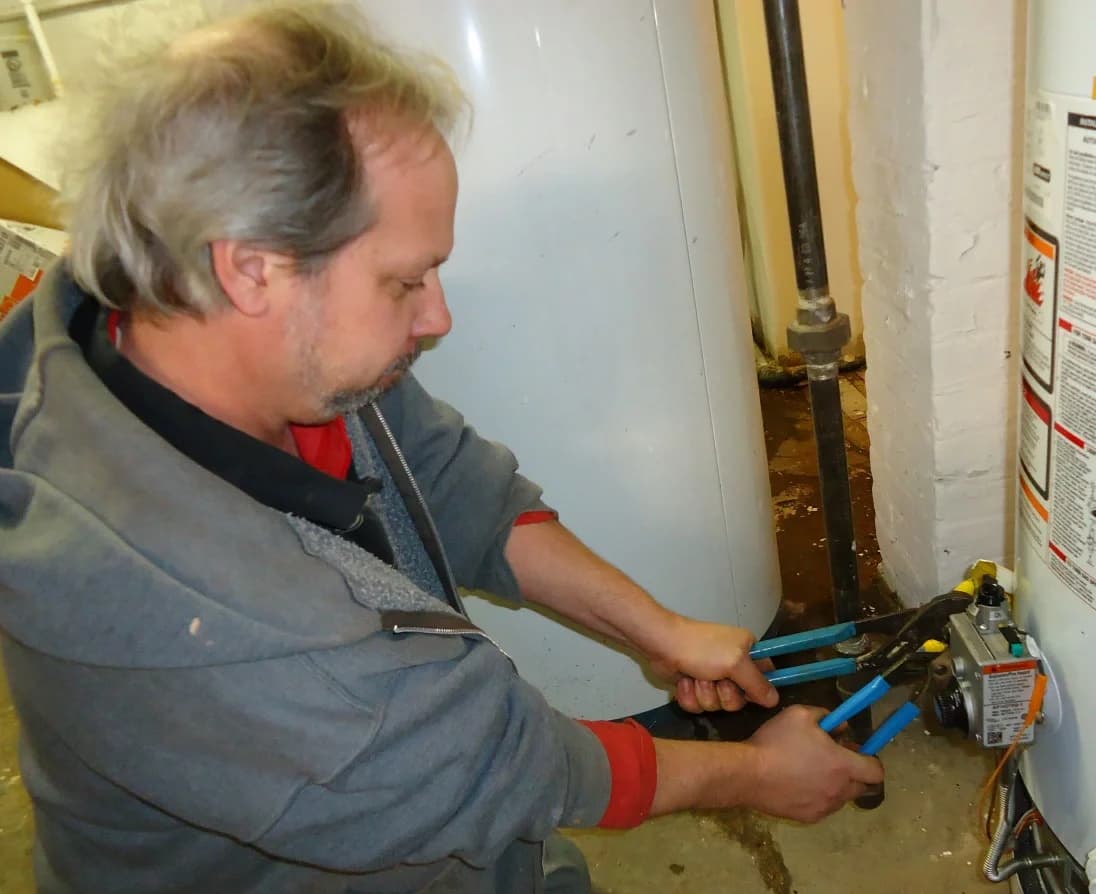
A water heater that is leaking from the tank itself needs replacing; the tank cannot be repaired. A unit with no hot water, lukewarm water or a tripping element is often a thermostat, element, thermocouple or gas valve — all repairable.
Most tanks last 8–12 years. If yours is past ten and failing, we will give you an honest comparison of repair versus replacement so you are not paying to fix a unit that is about to go.
Same-day water heater replacement in Central Maine
We keep common electric and propane tank sizes available and can usually replace a failed unit the same or next day. Customers have called us at 1 pm and had hot water again by dinner.
Installation includes removing and disposing of the old unit, new supply connections and shut-off, a code-compliant relief valve and drain line, a drip pan where needed, and a full test before we leave.
Tankless and hybrid heat-pump water heaters
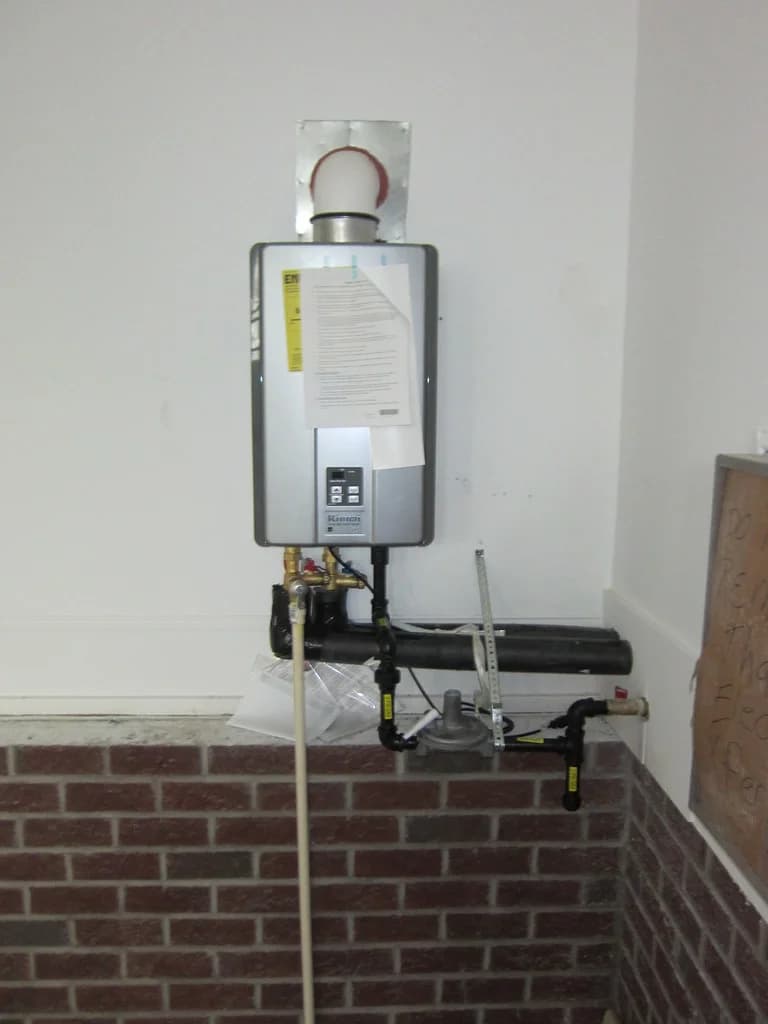
Tankless units give endless hot water and free up floor space, but need the right gas supply and venting. We will tell you whether your home is a good fit before you buy.
Hybrid heat-pump water heaters use a fraction of the electricity of a standard electric tank. Efficiency Maine offers rebates on qualifying units — ask us what applies to your installation.
Water heater maintenance on well water
Flushing sediment yearly and checking the anode rod every few years extends tank life, especially on well water with high mineral content — common around Augusta, Manchester and Winthrop.
We can add an expansion tank, replace a corroded relief valve, or set your temperature to a safe, efficient 120°F while we are there.
What does water heaters cost in Maine?
$1,500–$3,500
Typical installed range for a standard 40–50 gallon electric or propane tank including removal of the old unit. Tankless and hybrid heat-pump units typically run $3,500–$6,500 installed. The exact price is quoted before work starts.
Every job starts with a free, no-obligation estimate — you get the exact price before any work begins.
What water heaters customers say
Amy Davidoff
May 2026
“I used RJC Plumbing for the first time. The entire experience was professional, friendly and a real pleasure. I needed to have a warranteed hybrid hot water heater. I was able to schedule an appointment and have the work completed in a timely manner.”
Jordan Shaw
December 2025
“The whole RJC team is fantastic. I called on a Friday afternoon after my hot water heater malfunctioned, they were here on Monday, worked with the manufacturer to overnight a part, and installed it. Throughout the whole process they were professional, friendly, and timely.”
Kathy McLellan
October 2025
“I was very impressed by how quickly Riley responded to my inquiry, and by how pleasant he was on the phone. Madison got me on the schedule right away. The hot water heater that they installed is top-notch. I never run out of hot water.”


Water Heaters: Tank, Tankless & Heat Pump — Parts, Brands & Fault Codes
Three different water heater technologies show up in Maine homes — a standard storage tank, a tankless on-demand unit, and a heat pump water heater — and each one fails, gets sized, and gets serviced differently. Picking the right one starts with two figures on the yellow EnergyGuide label every unit carries: its Uniform Energy Factor (UEF), the U.S. Department of Energy's efficiency score, and its expected service life.
The brand sections below cover five manufacturers we install and service regularly — Rheem, A.O. Smith, Bradford White, Navien, and Rinnai — with the real fault indications each one documents, cited to the manufacturer's own service literature. A status light or error code only means something once we've confirmed the exact brand and model it came from; the same flash pattern can mean two different things on two different valves.
Tank, Tankless, or Heat Pump: Which Fits Your Home
| Type | How it's rated | What drives the decision |
|---|---|---|
| Tank (gas or electric) | Sized by tank gallons; UEF around 0.90-0.95 for electric, and ENERGY STAR sets 0.81-0.86+ as its high-efficiency bar for gas | Lowest upfront cost, familiar footprint, recovers a full tank between uses |
| Tankless | Sized by maximum flow rate (gallons per minute) at a given temperature rise rather than tank volume; ENERGY STAR requires UEF 0.95+ for its high-efficiency tier | No standby heat loss, endless hot water, but needs adequate gas supply and, on well water, a softener to protect the heat exchanger from scale |
| Heat pump (hybrid electric) | ENERGY STAR requires UEF 3.30+ for a standard integrated unit; the best-available models reach into the high 3-point range | Lowest operating cost by a wide margin, but needs roughly 6 feet of ceiling clearance, enough air volume, and a condensate drain in the room it sits in |
Anode Rods, the T&P Valve & the Expansion Tank
A tank water heater's anode rod is a sacrificial piece of metal that corrodes on purpose, protecting the steel tank lining from rusting through. Once it's fully consumed — sooner in homes on well water with harder, more mineral-heavy supply — the tank itself starts corroding, and no amount of maintenance after that point buys back time. Checking the anode rod periodically and swapping it before it's gone is the single biggest lever on how long a tank actually lasts.
The temperature-and-pressure (T&P) relief valve is the tank's last line of defense: if the water inside gets too hot or the tank pressure climbs too high, it opens and discharges before the tank can rupture. It should never be capped or plugged, and a valve that's actively dripping needs to be replaced, not ignored.
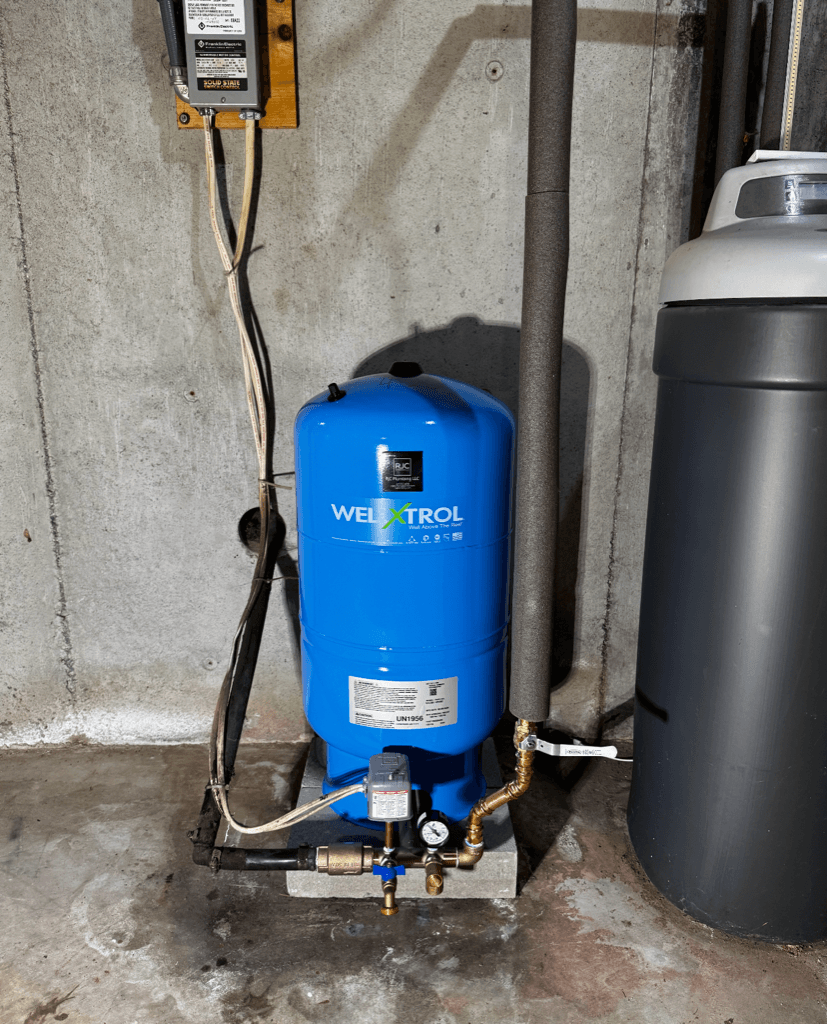
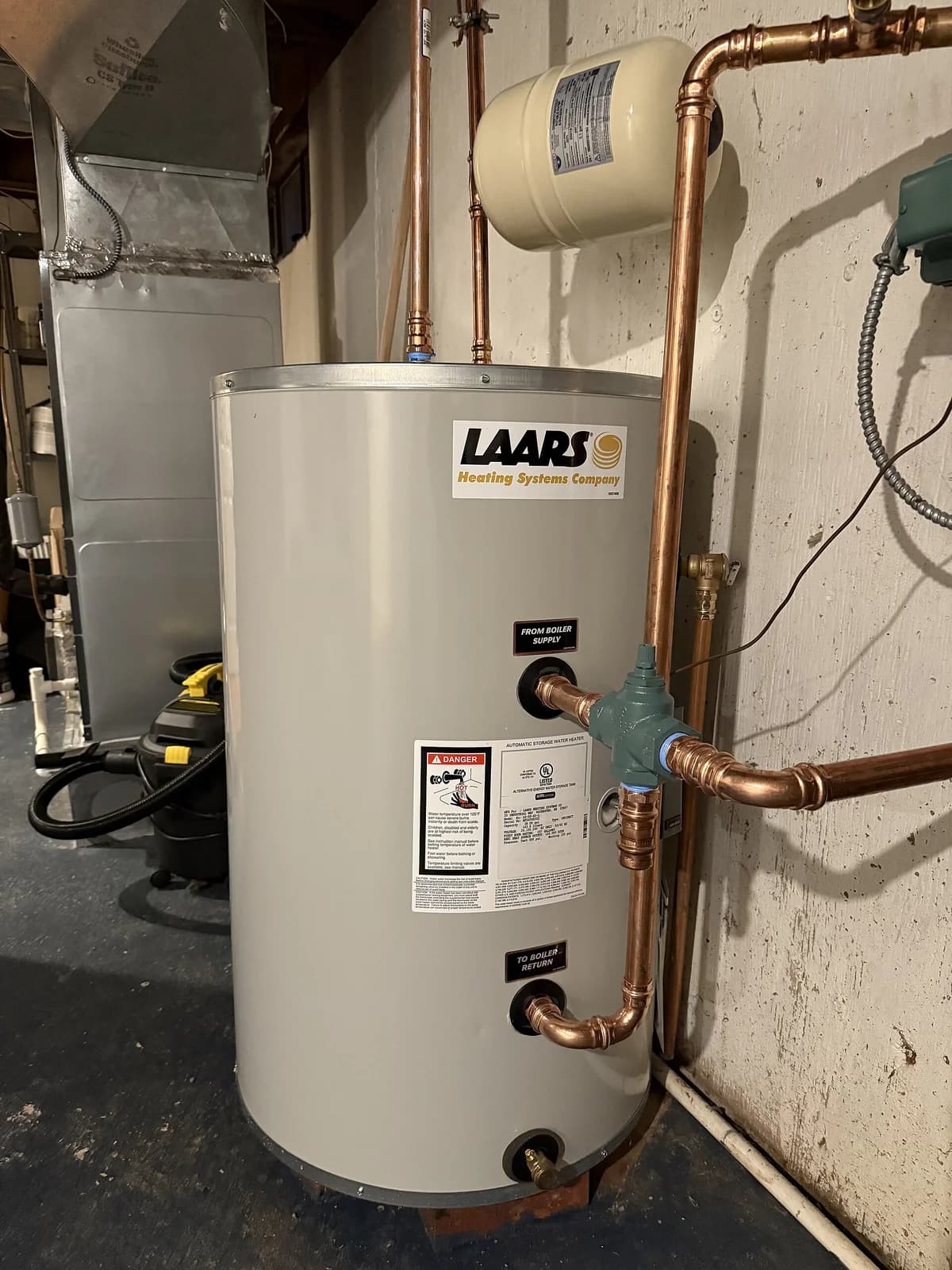
An expansion tank isn't part of every installation, but it's required on a growing number of Maine systems: once a check valve or pressure-reducing valve is added at the meter, the plumbing becomes a closed system, and water expands as it heats with nowhere to go. The expansion tank absorbs that extra volume so the T&P valve isn't doing that job on every heating cycle.

Rheem / Ruud — Gas Control Status Lights
Rheem's residential gas tank water heaters (sold under Ruud as well) use an integrated gas control valve with an LED that flashes in a defined pattern. Two control generations are common in the field: the older Robertshaw control, read as a flash count before and after a one-second pause, and the newer White Rodgers Intelli-Vent control used since 2007, which shows a numbered error instead.
| Flash pattern | Condition | Meaning |
|---|---|---|
| Slow blink / none | Standby | Normal — tank is up to temperature, waiting |
| Fast blink / none | Call for heat | Normal — burner should be firing |
| 1 / 1 | Ignition failure | No flame detected after repeated attempts — check gas supply and igniter |
| 2 / 1 | Flammable vapor sensor tripped | Do not bypass; needs a professional |
| 4 / 2 | ECO (high-limit) tripped | Water exceeded the safety temperature limit |
| 4 / 3 | False flame detected | Control senses flame with the valve closed |

Bradford White — Two Gas Control Generations
Bradford White's service documentation for its flammable-vapor-resistant gas models covers two control generations: the older White Rodgers Electronic Gas Control, and the current ICON System control, which adds an LED color (green/yellow/red) on top of the flash-count pattern the older control introduced.
| LED pattern | Status | Probable cause |
|---|---|---|
| 1 flash, 3-sec pause | Normal operation | Waiting for a call for heat |
| 2 flashes, 3-sec pause | Weak pilot signal | Thermopile failure or unstable pilot |
| 4 flashes, 3-sec pause | Excessive tank temperature | Sensor or gas control needs service |
| 6 flashes, 3-sec pause | Water leak detected | Accessory leak-detection module found water in the drain pan |
| 8 flashes, 3-sec pause | Pilot stuck on at OFF setpoint | Gas control needs replacement |

A.O. Smith — Model-Specific, Not a Universal Chart
A.O. Smith takes a different approach than Rheem or Bradford White: rather than a single published flash-code chart, its gas control valves direct owners to a QR code on the unit's rating plate that pulls up documentation specific to that model. We read the rating plate and pull the exact manual before diagnosing an A.O. Smith control, the same way we treat any brand whose codes are model-specific rather than universal — it takes an extra step, but the information matches the unit in front of us.

Navien & Rinnai Tankless — Reading a Code Correctly
Both Navien and Rinnai display a numeric code on the unit's digital remote controller when a tankless heater locks out, but neither publishes one universal cross-model chart the way some manufacturers do — both direct owners to the model-specific installation manual, or to their own technical support line, to interpret a code and trace its root cause. Navien's controllers also keep a short history of recent codes in memory, which is worth reading before a service call: it shows whether a code was a one-time event or a repeating pattern.
Because the same number can mean something different from one model line to the next, we confirm the exact model before touching anything, then pull that model's manual rather than working from memory or a generic list.

Rinnai's Own Guidance
Rinnai is direct about this on its own support pages: error codes vary by product line, and Rinnai points owners to the unit's installation and operation manual, or to Rinnai support directly, rather than a single chart that would apply across every model it sells.
Hard Water & Tankless Descaling
Maine's private well water commonly runs hard, and hardness can shift by season and by well. A tankless heat exchanger scales up faster on hard water without a softener or a periodic descaling flush, and manufacturers are explicit that heat-exchanger failure from unaddressed scale is not a warranty repair. A unit on well water without a softener is worth checking annually regardless of what a water test showed when the softener — or the house — was new.
Repair or Replace?
ENERGY STAR's own guidance is blunt about age: once a water heater passes 10 years old, plan for its replacement on your own schedule rather than waiting for it to fail on its own. The warning signs line up with what we see in the field — visible corrosion, water at a fitting or seam, rusty hot water, a drop in available hot water from sediment buildup, and rumbling or popping sounds as sediment traps and boils water under the burner or element.
None of that means every repair is a bad idea — a control valve, thermocouple, heating element, or thermostat on a unit under 8-10 years old is usually a straightforward, worthwhile fix. The one repair that never makes sense is patching the tank itself: once water is seeping from the tank shell rather than a fitting, the inner tank has corroded through, and replacement is the only real option.
If you smell gas near a water heater, leave the area and call your gas utility or 911 from outside the home rather than investigating it yourself. If a carbon monoxide alarm sounds, get everyone out and call 911.
Sources: ENERGY STAR — Residential Water Heaters Key Product Criteria · ENERGY STAR — When Should You Replace Your Water Heater · U.S. DOE (FEMP) — Purchasing Energy-Efficient Residential Water Heaters · Rheem/Ruud Technical Service Bulletin 1619 — Guardian PowerVent Flash Codes (Robertshaw Control) · Rheem/Ruud Technical Service Bulletin 1621 — White Rodgers Intelli-Vent Control · Bradford White Service Manual 238-51542-00 (Atmospheric Vent Gas) · A.O. Smith (hotwater.com) — Product Documentation Library · Navien Support · Rinnai Residential FAQ (error codes)
Brand names and logos are trademarks of their respective owners, shown only to identify the equipment discussed. RJC Plumbing is an independent contractor and is not affiliated with or endorsed by these manufacturers.

Efficiency Maine
Rebates & Guidance
- Rebate
$1,150 off a heat pump water heater, right at checkout
Efficiency Maine's instant discount takes $1,150 off a qualifying heat pump water heater at participating Maine retailers and distributors — there's no separate rebate form to mail in. Any ENERGY STAR certified heat pump water heater qualifies, in any tank size, and it does not have to be installed by a Registered Vendor to count. We'll tell you up front whether a given unit is on the eligible list before you buy it.
Source: Efficiency Maine - Recommendation
The room it sits in matters as much as the unit itself
A heat pump water heater pulls warmth out of the surrounding air, so it needs roughly 6 feet of ceiling clearance and enough air volume around it to breathe, plus somewhere for the condensate to drain. Cram one into an undersized closet and it can trip into backup electric-resistance heat, which quietly erases most of the savings. We check the space before quoting one.
Source: Efficiency Maine - Recommendation
A standard electric or gas tank doesn't carry this discount
Only the heat pump format qualifies for Efficiency Maine's instant discount — a straight electric-resistance or gas tank replacement is priced on its own, and is still often the right call for a tight mechanical room or a smaller budget. We'll price both side by side so the decision is an informed one, not a guess.
Source: Efficiency Maine - By the numbers
One discount per address, per year
Efficiency Maine limits this to one heat pump water heater discount or rebate per installation address per calendar year, and the instant discount can't be combined with the mail-in rebate on the same unit — it's one or the other. If you buy from a retailer outside the instant-discount network, the mail-in rebate has to be postmarked or submitted within six months of the purchase date.
Source: Efficiency Maine
Program details as of Sep 26, 2026. Rebate amounts and eligibility change; confirm current terms at efficiencymaine.com.
Water Heaters questions from Augusta homeowners
How fast can you replace a failed water heater?
Often the same or next day. Common sizes are readily available and, when a specific model is needed, we work with the supplier to get it quickly. Call as soon as you notice a leak.
Should I choose a tank, tankless or heat-pump water heater?
Tank: lowest up-front cost and simplest. Tankless: endless hot water, but needs adequate gas supply and venting. Heat pump (hybrid): lowest operating cost on electric, needs a space with some air volume. We recommend based on your home and usage.
Do you install water heaters on well water?
Yes, and we will talk you through the sediment and mineral issues that affect tank life. A sediment filter or softener ahead of the heater helps on hard well water.
Will you remove and dispose of my old water heater?
Yes. Removal and disposal of the old unit is included in every replacement.
Do you service all water heater brands?
We repair and replace all major residential brands — electric, propane and natural gas — including warranty replacements where the manufacturer authorises a local plumber.
What size water heater do I need?
For most families a 40- or 50-gallon tank. Larger households or soaking tubs may need 65–80 gallons or a tankless system. We size it based on your bathrooms and peak use.
Related plumbing services
- Kitchen Plumbing
- Bathroom Plumbing
- New Construction
- Emergency Repairs
- Pipe Repair
- Drain Cleaning
- Well Pump Repair
- Sump Pumps
Water Heaters across Central Maine
Get a free water heaters estimate
Tell us what you need and we will get right back to you — usually within a few hours.
Need it today?Call (207) 549-0064
More ways we can help
Google reviewsPlumbing services
9RJC Plumbing handles the full range of residential plumbing, including
Service areas
17You will find our truck across Central Maine, from
- Central Maine service areas
- Plumber in Augusta, ME
- Plumber in Brunswick, ME
- Plumber in Waterville, ME
- Plumber in Gardiner, ME
- Plumber in Hallowell, ME
- Plumber in Winthrop, ME
- Plumber in Farmingdale, ME
- Plumber in Manchester, ME
- Plumber in Winslow, ME
- Plumber in Oakland, ME
- Plumber in Topsham, ME
- Plumber in Bath, ME
- Plumber in Lewiston, ME
- Plumber in Auburn, ME
- Plumber in Lisbon, ME
- Plumber in Sabattus, ME
Guides & tips
4Our blog covers the questions we hear most, such as
Company
4You can also visit